Unesco has just published the latest version on its Atlas of the World’s Languages in Danger edited by Christopher Moseley (the original 1996 and 2001 editions were edited by the late Stephen A. Wurm). The on-line interactive version of the Atlas is now available and the book version is due out soon. There is also a downloadable map in .pdf format (warning, it’s 20 Mbytes in size and unless you have access to a very large monitor or printer it is not terribly usable).
The editorial group who assisted Moseley is a veritable who’s who of specialists in endangered languages, including 27 experts from 13 named regions, supplemented by 6 specialists who provided “complementary information on specific areas”. Having spoken to several of the contributors personally (including one colleague I met in Tokyo last week), it appears that preparation of the database underlying the Atlas was not all harmony and light and resulted in some disagreements among contributors. Not so unusual in endangered languages research, I guess.
I had a little cruise around the interactive presentation, which uses a Google Maps interface and noticed quite a few oddities in regions where I have a little knowledge. Perhaps readers of this blog will notice more. There is a “Contribute your comments” link to the website but it appears to be broken because all it does is display the same page. There doesn’t seem to be anywhere one could point out apparent errors to Unesco and the editor, however it is possible to comment on individual listed languages by clicking on their “pin” on the Google Map and going to the “Comments” tab in the information that pops up. The comment then disappears and where it goes is not at all clear.
Here are a few other things I noticed:
 Follow
Back in Tokyo
9 February 2009
David Nathan, Director of the Endangered Languages Archive, at SOAS, and I are back in Tokyo at the invitation of Toshihide Nakayama of ILCAA, the Institute for Languages and Cultures of Asia and Africa, at Tokyo University of Foreign Studies for 10 days to run a workshop on language documentation that follows up our 2008 workshop. This year we are taking a different tack and focusing the week of seminars and practical sessions on the principles and practices of archiving endangered languages materials. The week begins on Monday (today) with preparations in the morning and David’s public lecture on “Archiving endangered language materials” in the afternoon. Classes begin in earnest on Tuesday and run until Friday, with sessions from 10am to 5pm each day. There will be 15 attendees, mostly students who are doing fieldwork in various locations around the world. Details of the workshop can be found here.
The topics we plan to cover include:
- Language documentation and language archiving – major issues
- Audio – good practices refresher
- Audio recording – how to make great audio
- Data and metadata – good practices refresher
- Data management practical
- Workflow for archiving
- Mobilisation and delivery of language materials
- Transcription, annotation, translation – good practices refresher
- IP and ethical issues in the delivery, usage, and archiving of materials
There will be group work in the practical sessions and a final discussion with presentations by the attendees on the last day. If time and energy permit I will blog about how the workshop goes and report on some of the outcomes.
Announcement: 3L Summer School
The Department of Linguistics at the School of Oriental and African Studies is proud to announce the second 3L International Summer School on Language Documentation and Description to be held in London 22nd June to 3rd July 2009 (information about the summer school is also available en français). Courses will be in English, with tutorial and practical sessions in French and English. There will be two conferences associated with the summer school (see below).

This two week summer school aims at introducing the concepts and practices of language documentation and its links to language description for future and novice field linguists. It will draw upon the extensive expertise of the three organising universities in the 3L Consortium: University of Lyon, Leiden University and the School of Oriental and African Studies, London. It follows on from the success of the first 3L Summer School held in Lyon in 2008.
Announcement: Puliima 2009: “Modern Ways for Ancient Words”
Puliima 2009 National Indigenous Language and Information Communication Technology Forum Koori Heritage Trust and William Angliss Institute Conference Centre, Melbourne, Australia 1st and 2nd April 2009 [UPDATE 11/2/2009 Puliima have announced that they have limited travel funds to be able to assist people, especially Indigenous people from North Queensland and Victoria, to attend. E-mail puliima2009@acra.org.au … Read more
Call for papers: FEL XIII: Endangered Languages and History
The Foundation for Endangered Languqages is holding its thirteenth annual conference this year in Tajikistan, in association with the Academy of Sciences of Tajikistan and The Institute of Humanities, Khorog.
Place: Institute of Humanities, Academy of Sciences of Tajikistan, Khorog Tajikistan
Dates: 24-26 September, 2009
Abstract deadline: March 1, 2009
The languages of the conference: English, Russian and Tajik. Abstract and papers will be accepted in any of these languages. Go to the conference website for further information. But I’ve put the conference themes below in full, because they make one think about history in a serious and interesting way.
Endangered Languages Week 2009
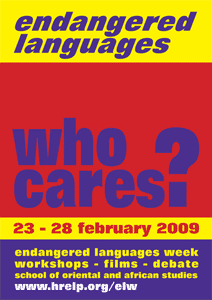
After the success of last year, we are running Endangered Languages Week 2009 at SOAS from 22nd to 28th February. The theme this year is “Endangered languages: who cares?”
Endangered Languages Week will presents a variety of displays, discussions, films, and workshops to provide a view of what is happening to languages around the world and what is being done to document, archive and support endangered languages at SOAS and elsewhere. Activities will include:
Beliefs and Ideology on Endangered Languages
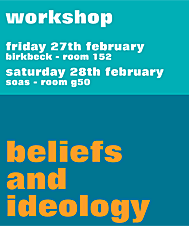
On 27th and 28th February we will be running a workshop at SOAS in London to discuss theoretical and practical issues concerning beliefs and ideologies on endangered languages, with a special focus on the implications they have for language support and revitalisation.
Language ideologies have been described by Jan Blommaert as ‘socioculturally motivated ideas, perceptions and expectations of language, manifested in all sorts of language use’. He goes on to suggest that ‘there is now a widespread recognition of language ideologies as a crucial topic of debate when it comes to assessing the motives and causes for certain types of language change’. The study of language ideologies and beliefs may therefore provide insights into the reasons for language shift and/or revival, and may help to determine the success or otherwise of language revitalisation projects. At the workshop we will be looking at several issues:
Wunderkammer
Over at the Project for Free Electronic Dictionaries, we’ve finally got the first version of Wunderkammer, our software for displaying multimedia electronic dictionaries on mobile phones, ready for release. We’ve also developed the application wkimport, which allows electronic dictionaries in a variety of formats to be imported relatively painlessly into Wunderkammer. The packages for importing … Read more
Honour and other people’s languages
Today’s Honours list [.pdf] gives Indigenous Australians something to celebrate – Mick Dodson as Australian of the Year and the award of a Companion of the Order of Australia to Faith Bandler.
And for Indigenous languages, there are two awards of Members in the General Division of the Order of Australia to celebrate:
1. the late Dr R. Marika, “For service to Indigenous communities in rural and remote areas as an educator, linguist and scholar, through the preservation of Indigenous languages and the promotion of reconciliation and cross-cultural understanding”
2. the Reverend Dr Bill Edwards, who has worked for over 50 years with Pitjantjatjara people, learning the language, helping with documentation, with schooling, who pioneered the teaching of Indigenous languages at university, and who still helps out as an interpreter in hospitals and gaols.
Both awards come in the shadow of a government decision which goes against what both Bill and Dr Marika have fought for. Bill has protested about the NT Government’s decision to close bilingual education in a letter to the Australian.
Dr Marika died before the decision was made. But in her 1998 Wentworth Lecture [.rtf], we can see what she would have said about the destruction of her hopes for two-way education.
How soon we get used to things
40 years ago in Adelaide I didn’t even know the name of the people whose country was officially invaded on 28 December 1836. Last Christmas walking in the city, I saw:
