Berigora: a word that clawed on — from where?

The challenge

Brown falcon drawing
Brown falcon  © J.N. Davies from Birdata

‘Australia’s Most Widespread’ bird, according to Birdata’s featured bird last week, is the Brown Falcon, Falco berigora. A few months ago, a ‘complete guide to the origin of Australian bird names’ (that is, English and Linnæan names), was published, and in it Fraser and Gray (2013:80) summarised the published information on this species name:

berigora [is] stated in many places to be the name for the bird in an indigenous language, though nobody appears willing to nominate a particular language. The original namers, Vigors and Horsfield (1827), simply said: ‘The native name of this bird, which we have adopted as its specific name, is Berigora’. Gould (1848) mentioned ‘Aborigines of New South Wales’ against the word, and Morris (1898), in his Dictionary of Austral English, claimed it is made up of beri, claw, and gora, long. The word does not appear in a glossary of the languages spoken by indigenous people of the Sydney region as the time of early white settlement (Troy 1994), though many other bird names do, and the bird was certainly to be found there. Are the claws longer than those of other falcons? Perhaps not, and indeed, the toes, according to Debus (2012:131), are shorter.

Actually Falco berigora Vigors and Horsfield 1827:184-5 is one of only three birds whose scientific (Linnæan) name draws on a word of an Australian language. ((The other two are Ninox boobook, Latham 1801:64, Southern Boobook owl, and Petroica (Muscicapa) boodang Lesson 1837:322, Scarlet Robin, each using the name that is well attested in the Sydney Language.)) The word berigora has managed to survive in this ornithological niche, and is now guaranteed as much as longevity as science can offer. But can we give due credit to the language which provided it?

Read more

Aboriginal Languages Workshop 2014

Don’t miss the annual Aboriginal Languages Workshop 2014 to be held at ANU’s beautiful Kioloa Coastal campus. The workshop web-page is up http://chl.anu.edu.au/languages/alw2014.php And for some previous workshops: 2012 on North Stradbroke Island and 2009 at Kioloa See the web-page for the call for abstracts – deadline: Jan 18, 2014.

ARC Centre of Excellence for the Dynamics of Language

We have great pleasure in announcing that the ARC has funded a Centre of Excellence for the Dynamics of Language over seven years. This project will be led by Nick Evans at ANU with a collaborative team from there, the University of Western Sydney, the University of Queensland and the University of Melbourne, and with many partners from other universities and institutions including AIATSIS and  Appen.

We want this to be a centre for collaboration, for generating  ideas and inspiration for linguistics in Australia and the world.  In the New Year we’ll be putting up a web-page to give more information, In the meantime, here’s an overview of what we are planning.

Read more

Research, records and responsibility conference: Ten years of PARADISEC

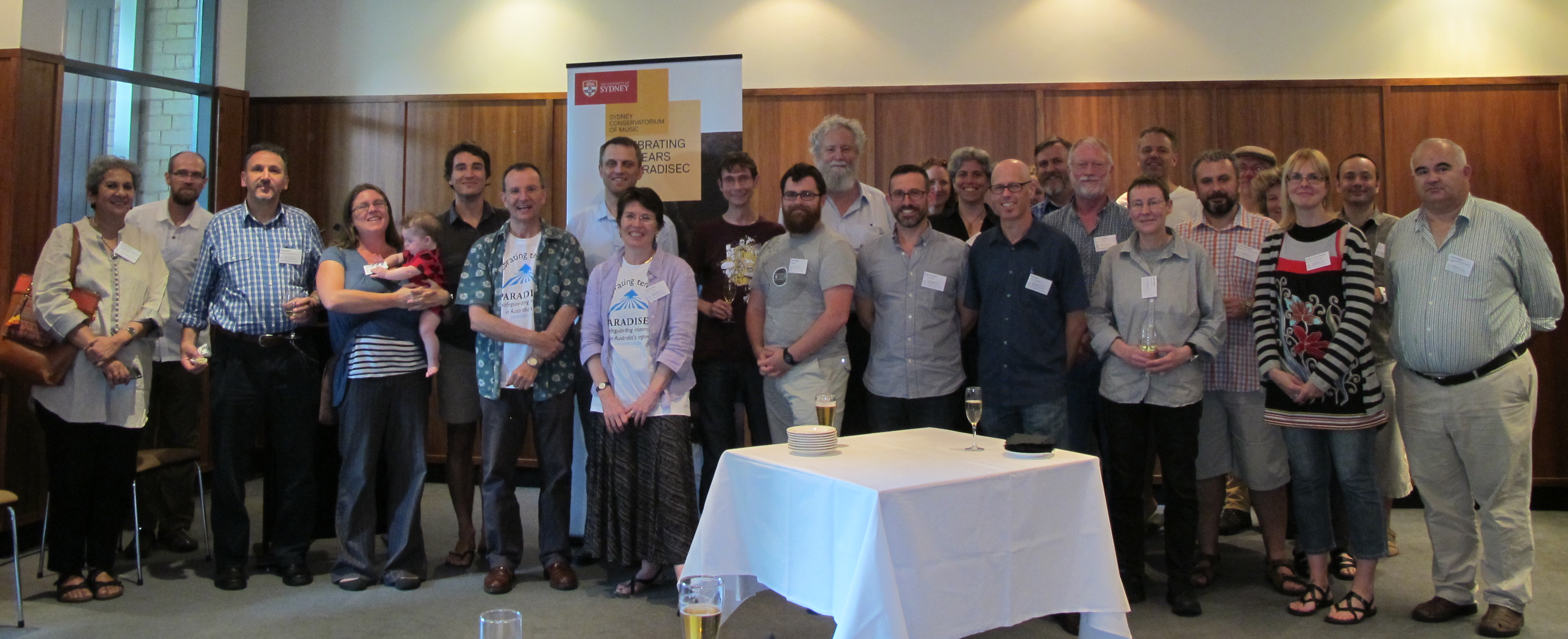
RRRReception

The conference celebrating ten years of PARADISEC in early December had a suitably interdisciplinary mix of presentations. Joining in the reflection on building records of the world’s languages and cultures were musicologists, linguists, and archivists from India, Hong Kong, Poland, Canada, Alaska, Hawai’i, Australia, the UK and Russia. The range of topics covered can be seen in the program: http://paradisec.org.au/RRRProgram.html

The conference ended with a discussion of what was missing in our current tools and methods. While it is clear that linguists have done pretty well at using appropriate tools for transcribing and annotating text, and building repositories to provide long-term citation and access to the material, there is still a long way to go.

Read more

Vale Peter Newton

Readers of this blog will be saddened to hear of the passing of Peter Newton last week after a short struggle with illness. Peter was a poet, linguist, writer and editor, Associate Sydney Jazz Club and Jazz Archivist. Peter worked closely with PARADISEC to identify, sort and catalogue the extensive linguistic collection of Arthur Capell, … Read more

The long road to language resources—CLARIN

CLARIN, the ‘Common Language Resources and Technology Infrastructure’ is a European initiative to support the creation, curation and exploration of language material for research purposes and for as broad an audience as possible. The stated aim is that you should not need to be a technical expert to use the corpora, lexica and annotations that are targeted in CLARIN.

It is part of the European Research Infrastructure Consortium (ERIC). This is a huge project, with a budget of some €104 million. CLARIN-D is the German section of CLARIN and it recently had its 2-year showcase, which I was able to attend (see current activities at http://clarin-d.net/de/aktuelles/). Given that this is the first two years of a longterm project it has clearly achieved a great deal already, and certainly more than can be glimpsed in a short blog post.

This is part of a ‘roadmap’ process that actually leads somewhere, unlike the Australian version I reported on earlier that appears to have cost hundreds of thousands of dollars only to have been abandoned even before it was published.

Read more

Light Warlpiri hits the news!

Wow! Light Warlpiri has hit the news big time. Carmel O’Shannessy just published a paper in Language on it. And it’s been taken up as news: The Atlantic, and you can see it and other renditions in Google News. And the Atlantic makes use of the material on Carmel O’Shannessy’s research page. OK – they … Read more

Supporting language use and learning

In the midst of Endangered Languages Week there is the good and the bad. The good was the delight of reading Rob Munro’s post on what his company Idibon intends to do for NLP for endangered languages. The company is advised by Chris Manning, and I learned today that his wonderful Warlpiri dictionary presentation tool … Read more