Ngapartji Ngapartji has launched a policy paper regarding Australian Indigenous languages. You can download it [.pdf] from their website. The press release is below.
 Follow
Mobile phone dictionaries
I am down in Adelaide at the moment delivering the Kaurna electronic dictionaries we’ve been working on to the Kaurna Warra Pintyandi group. We’ve produced a Kirrkirr Kaurna dictionary and a mobile phone Kaurna dictionary, based on the work of the 19th century German missionaries Christian Teichelmann and Clamor Schürmann. Both dictionaries were well received. The mobile phone dictionary seemed to be particularly well received by the young people, but I guess we can really appreciate these things. I’ve put up a demonstration version of the dictionary for download so that a wider audience can try it out. I’ve also put up information about how the dictionary works and provided the source code and instructions on how to port other dictionaries into the program.
Top of the Pops
The Books section of the website of The Guardian newspaper here in the UK has a feature they call Top 10s. These are lists prepared by a prominent author featuring their pick of the top 10 items within a topic area, one usually connected to the publication of one of their books. There are the kinds of lists you might expect, like Sarah Anderson’s Top 10 books about wilderness, or Alison MacLeod’s top 10 short stories. But there are also cute ones like Simon Critchley’s top 10 philosophers’ deaths (would linguists’ deaths be quite so interesting?).
In connection with the recent publication of the book I edited called 1000 Languages, The Guardian asked me to prepare a Top 10 endangered languages list. “Great”, I thought, “given my interest in communicating about our work, here’s a way to reach thousands of Guardian readers and others and get them interested in what we do as linguists, as well as highlight some issues about endangered languages. But how do you pick 10 languages out of a potential list of 3,000 (or over 6,000 if Michael Krauss is to be believed?)”
It was an impossible task, so I figured I’d set some parameters and see what I came up with. I decided on the following rules of thumb:
The Growing PARADISEC Collection
Following on from Aidan’s blog last week announcing that PARADISEC‘s archive has reached 2000 hours of recordings, here is some of the detail about what’s in our digital archive. Along with Mark Durie’s collection from Aceh, described in the last post, are other collections from Bangladesh, Cambodia, Indonesia, China, the Cook Islands, Fiji, French Polynesia, Hawaii, India, Indonesia, Japan, Kiribati, Korea, Lao, Malaysia, the Marshall Islands, Micronesia, Myanmar, Nauru, Nepal, New Caledonia, New Zealand, Niue, Norfolk Island, Palau, Papua New Guinea, the Philippines, Reunion, Samoa, Solomon Islands, Sri Lanka, Taiwan, Thailand, Timor-Leste, Tonga, Tuvalu, Vanuatu, Vietnam, and Wallis and Futuna.
There’s copying, and there’s research
This is a follow up to my posting about materials from the Kamilaroi/Gamilaraay Web Dictionary and my 1993 book Reference Dictionary of Gamilaraay, northern New South Wales being copied without attribution, repackaged and sold in book form.
The ever vigilant David Nash has brought to my attention this wiki which contains Gamilaraay language materials with English glosses, roughly 100 vocabulary items in all. The site is organised into eight subsections:
- Topics
- Adverbs
- Interjections
- Nouns
- Particles
- Verbs
- Pronouns
- Suffixes
Copy, right?
Today I have a story to share that involves intellectual property violations, taking materials without attribution from a copyrighted dictionary of an Australian indigenous language, and publication of a book that contains such bad scholarship, ridiculous claims, nonsense, and stupid howlers that it is actually funny.
Over the past couple of years I have presented sessions at various workshops and training courses (most recently at a grantee training workshop held at SOAS 11-17th June) on the topics of "ethics, intellectual property rights and copyright". I have learnt a bit about copyright and moral rights in the process – my Powerpoint slides for the most recent presentation can be found here.
One of the issues that is often raised by fieldworkers and researchers during these presentations can be summarised as: "I don’t want to make my data publicly available because someone will steal it and publish it under their own name". I usually reply in terms of the low likelihood of such an event happening (as Andrew Garrett said at an archiving workshop at the January 2008 Linguistic Society of America annual meeting (and I paraphrase): "Sorry to tell you this, but actually no-one wants to steal your data") and the protection afforded by copyright and moral rights (mentioning the World Intellectual Property Organisation and various other lobby groups).
Well, unfortunately, I have to change my tune, folks, because it has happened to me. A subset of materials which I have published in book form (and deposited as Word .doc files with the ASEDA archive) and co-published with David Nathan on the web as the Kamilaroi/Gamilaraay Web Dictionary that are all clearly marked as copyright have been reproduced without attribution or recognition of our authorship both on a website and in a recent book publication. Fortunately, they have been done in such as way as to reveal the ignorance of the violator that is truly laughable. Sadly, this individual is attempting to profit financially from both our intellectual property and that of an Australian Aboriginal group, along with potentially damaging the trust we have built up by years of work with the community.
The story goes like this.
Directions in Oceanic Research – Call for papers
So you haven’t had enough conferences on languages of the Pacific – or you missed AFLA and the Papuan languages workshop??
Head to Ourimbah, 9-11 December 2008 for for the Directions in Oceanic Research (DOR) conference.
Here’s the info:
2000 Hours
Early this morning, a delivery of audio files was quietly sent from Paradisec’s local server at the University of Sydney to permanent near-line tape storage at the Australian Partnership for Advanced Computing in Canberra. This happens on many days, as you might imagine, but what makes today’s delivery special, was that somewhere in that bunch of files was our 2000th archived hour of audio.
Moreover, we will soon be celebrating five years of operations, in which case, 2000 hours might not seem so impressive – it’s just 400 hours per year after all – but we at Paradisec are very proud of our collection. Especially given that just about everything here is done on a shoestring budget and there have been some lengthy hiatuses of funding lately.
Speaking of which, this may be an opportune time to mention that we are always amenable to generous donations from people wishing to sponsor the digitisation and preservation of a collection of data. See our website for more details.
So, just which file was the lucky 2000th hour? Well, we can’t really be sure, but we do know that it was among a collection of Mark Durie’s research into the dialects of Aceh, an area that was devastated by the Indian Ocean tsunami of Boxing Day 2006.
To help us celebrate both these milestones, Mark has kindly written a small piece for us about Aceh’s dialects, his research of them and the importance of preserving the collection. He has also allowed a small portion of one of these recordings to be posted with this piece, which you can download here.
3L Summer School
As it approaches the halfway point, the 3L (Leiden-London-Lyon) Summer School on Language Documentation and Description is humming along. It started on Monday 23rd June and ends on Friday 4th July.
So far we have had five days of plenary lectures (in English) and discussions (in English, and French) on a range of topics, practical classes (on phonology, tonology, audio recording, Toolbox, multimedia, applying for research grants — most available in both English and French), and areal classes (on Cushitic, and Mayan languages). There is a full list [.pdf] of course descriptions on the 3L website. There are around 65 students and researchers attending from a wide range of countries as varied as Togo, Gabon, Colombia, Venezuela, Brazil, Guatemala, USA, Netherlands, Germany, France, Russia, UK, Taiwan and Australia. Teachers are from the University of Lyon-2, SOAS and Leiden. The local organisational team is made up of students and staff from Lyon-2 together with student volunteers.
On Wednesday evening there was a very interesting soirée which brought researchers and students attending the 3L Summer School together with researchers and students attending a summer school on Interactional Linguistics being run by the CNRS ICAR laboratory headed by Professor Lorenza Mondada at the recently opened École Normale Supérieure de Lyon (with brand new architecturally outstanding buildings and facilities). There were many interesting issues of common interest that surfaced in the short presentations given by researchers from the two groups, including problems of fieldwork (entering, being in and leaving the field, the role of gatekeepers and brokers), research methods and tools, and giving back to those participating in the research. There are sure to be more useful interactions between the ICAR and DDL research groups in Lyon in the future.
Today there is a student conference, or rather two conferences since there will be presentations of around 20 papers in two parallel sessions, one in French and one in English. The students are so keen to discuss their work that the programme starts at 9:30am and goes to 7pm (on a Saturday, mind you!). This level of enthusiasm and willingness to share ideas and experiences has been a feature of the past week both in class and outside.
Some other features of the summer school so far that I have noticed include:
1000 Languages
I just received copies from the publishers of a new book that may be of interest to readers of this blog. It is called 1000 Languages: The Worldwide History of Living and Lost Tongues and is edited by yours truly. The book was published by Thames and Hudson in the UK and associated countries, and by University of California Press in the US. It is available on UK Amazon, or readers in the UK can get it for an even cheaper price via the Tesco on-line store.
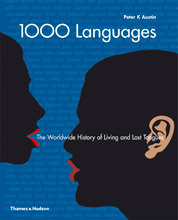
The book is issued in hard cover and runs to over 300 pages and includes over 400 colour illustrations, a series of maps, a glossary of linguistic terms, and a list of references. It is organised topically by geographical regions and each chapter explores the sources, interrelationships and characteristics of that region’s languages, including the major and minor ones of the area. It includes chapters on the topical issues of endangered and extinct languages. Each main entry details numbers of speakers, geographical spread, growth, development and key features of the language. The following is a list of the chapters and authors: