This week’s Chronicle of Higher Education has two articles by Peter Monaghan on endangered languages issues. The first is entitled Languages on Life Support: Linguists debate their role in saving the world’s endangered tongues (viewable free on line, and includes material from interviews with Nick Evans, Michael Krauss, Richard Rhodes, Noam Chomsky, and myself. Some of the topics covered will be familiar to readers of this blog, like what Monaghan calls “a ‘commando style’ of recording trip” (something Jane wrote about as Fifo (fly in fly out) fieldwork).
 Follow
Good news!
The Australian Research Council have funded a project 2009 – 2012 Strategies for preserving and sustaining Australian Aboriginal song and dance in the modern world: the Ngarluma community of Roebourne, WA. The researchers are Sally Treloyn (CDU); Allan Marett; Andrew Dowding, Ngarluma Aboriginal Corporation Project Summary This project makes a major contribution to the community … Read more
Wunderkammer update
Work continues on the Wunderkammer software package, which makes electronic dictionaries available on mobile phones. A new version of the package, with new features and bug fixes, is available from the Wunderkammer website: http://www.pfed.info/wksite/ We’ll be presenting the Wunderkammer software and talking about some of the dictionaries that use it on 1 June 4pm to … Read more
Send a letter to a Minister – Ngapartji Ngapartji
[From Alex Kelly, Ngapartji Ngapartji and BIGhART] Dear friends and supporters, After 5 years working on Ngapartji Ngapartji, building the language website [and see blogpost] and touring the show, we have the opportunity to engage with the people who can help move the issue of Indigenous languages forward in leaps and bounds. Currently, without any … Read more
Endangered languages and finances
The financial difficulties currently facing the world’s economies are having an impact on funding and support for research on endangered languages in various ways. (I heard the current situation referred to in Australia last month as The GFC (“Global Financial Crisis”), an acronym that I initially confused with The BFG (as a Roald Dahl fan) … Read more
EuroBABEL projects announced
As I reported back in October 2007, the European Science Foundation has been working on a project called EuroBABEL(standing for “Better Analyses Based on Endangered Languages”) as part of the EUROCORES collaborative research infrastructure. The main goal of the EuroBABEL is:
“to promote empirical research on underdescribed endangered languages, both spoken and signed, that aims at changing and refining our ideas about linguistic structure in general and about language in relation to cognition, social and cultural organization and related issues in a trans-/multi-disciplinary perspective”
After a complex selection process that involved review by an international expert panel and then negotiations with national funding agencies, ESF has just announced the successful EuroBABEL projects:
Gayarragi, winangali, a new language resource – David Nathan
from David Nathan,
HRELP, Endangered Languages Archive, SOAS
Gayarragi, winangali, a new Gamilaraay/Yuwaalaraay language resource, is now available. Click on the picture to download.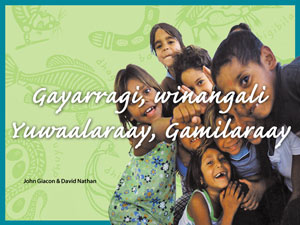
Gayarragi, winangali is an interactive multimedia resource for the Gamilaraay and Yuwaalaraay languages of northern New South Wales, Australia. It is aimed at language learners at all levels, and anyone interested in these languages. It contains extensive language material, including audio. The main features are:
Fieldwork workshops
It seems that linguistic fieldwork has become a topic that is attracting quite a lot of interest lately. As Sheena Van Der Mark from La Trobe University recently wrote, there will be a workshop on Non-linguistic aspects of fieldwork at the Australian Linguistic Society annual conference in July.
On the 22nd of this month, SOAS Linguistics Department will be hosting a workshop on Teaching field linguistics techniques, organised in conjunction with the LLAS, the Subject Centre for Languages, Linguistics and Area Studies, the UK national body which supports teaching of languages, linguistics and area studies in higher education. We anticipate roughly 40 attendees, including students interested in learning more about fieldwork, and staff who are considering how fieldwork might fit into the linguistics curriculum. Presentations will be given by staff and post-graduate students from SOAS, Manchester University and Queen Mary, University of London, covering the following topics (in line with my remarks from two years ago here and here (see especially the comments section), we are aiming to cover a range of fieldwork types, including language documentation-type fieldwork and urban sociolinguistic-type fieldwork):
Samson and Delilah
A couple of weeks ago I watched “Samson and Delilah” at the Alice Springs Telegraph Station along with maybe 1700 other people, black and white, on the grass or swags and a few on camp chairs. It was a spectacular place for a premiere, the screen set up against red cliffs and white gums.
Several reviews have come out, by David Stratton, and by Julie Rigg on the ABC.
It’s a bleak fairytale that’s beautifully filmed and staged – the light at different times of day and in different places, the shadows when Samson is dancing, the strangeness of living under a bridge in the Todd River.