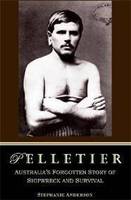
‘Anco’ Pelletier

Narcisse Pelletier1 (1844-1894) spent half his adult life (1858-1875) with Aboriginal people on the eastern coast of Cape York Peninsula. He learnt their language and had no contact with outsiders, and in time he lost command of his native French. His removal from the coast at Night Island was as out of his control and as sudden as had been his arrival there seventeen years earlier. He then regained command of French over subsequent weeks and months, and upon return to his birthplace in France, he was interviewed by Constant Merland (1808-85) a French surgeon-turned-savant. Merland’s 1876 book Dix-sept ans chez les sauvages: Narcisse Pelletier is quite rare and apparently not held in any Australian library. It had been overlooked as an ethnographic source but last month it has appeared afresh and “Now, for the first time, this remarkable true story is presented in English, complemented by an in-depth introductory essay and ethnographic commentary” as the blurb accurately states.

The translator and annotator Stephanie Anderson has marshalled the help of anthropologists and linguists Athol Chase, David Thompson, Bruce Rigsby, Peter Sutton, and Clair Hill. Between them they show that the people who adopted Pelletier were speakers of a dialect of the language now known as Lockhart River ‘Sand Beach’ language comprising Kuuku Yaʔu and Umpila, probably the dialect known as Uutaalnganu, AIATSIS code Y211.

cover

The full account is spread through Pelletier : the forgotten castaway of Cape York published by Melbourne Books. The volume includes an ethnographic commentary by Athol Chase and an introductory essay by Stephanie Anderson who you might have heard talk about this in mid July on ABC’s Late Night Live.

Merland has a chapter on language. He had taken down some 70 words and a few longer expressions as recalled by Pelletier, but before he presents these, he starts from the general, “How thought is expressed”:

one point on which most people agree is that the degree of civilisation of different peoples can be gauged from the degree to which their language has evolved (p185)

Merland found that the language he recorded from Pelletier did not have the primitive properties that contemporary theorists described. Merland refers to the view that

Man’s first words were necessarily imitative words, onomatopoeic words, as grammarians call them (p185)

then points out that, on the contrary, judging from Pelletier’s vocabulary,

while there are still numerous monosyllabic words in our highly evolved language of French, these have completely disappeared from the language spoken by the savages of Endeavour Land. (p191)

Indeed, Merland records not one monosyllabic word — just as we with hindsight would expect of a Pama-Nyungan language(!).

Merland’s transcription (possibly influenced by Pelletier’s own spelling suggestions) has a few words with syllable-initial tr. These words match up with phonemic apical stop (apico-alveolar or possibly -domal) in Kuuku Yaʔu as recorded by the Rev DA Thompson (1988):

Read more

Australian Indigenous language funding

Two Ministers responsible for different aspects of Indigenous Affairs in Australia, Jenny Macklin and Peter Garrett, have jointly announced $9.3 million of funding for Indigenous languages. The grand aim is to “to help take 113 indigenous languages off the critically endangered list.”
Some good stuff:

“A focused and coordinated national approach is critical to safeguard indigenous culture and save these unique languages.”
Communities will be encouraged to use endangered languages as much as possible and all efforts will be made to pass them on.
… The policy will also encourage the teaching of indigenous languages in schools”

Some bad stuff:

“although it is understood not to alter the course in the Northern Territory, where bilingual education is set to be scrapped in 2010.” (out of date… in several schools, energetic principals and superintendants have already enthusiastically closed down bilingual programs).

Read more

Look What They’ve Done to My Song (and other time-aligned data and analysis), Ma

At the Linguistic Society of America Summer Institute in Berkeley last week (17-19th July) the National Science Foundation sponsored Cyberling 2009, a workshop exploring how computational infrastructure (called “cyberinfrastructure” in the US, and e-Science or e-Humanities in the UK) can support linguistic research in a variety of fields. There was a panel discussion about data sharing that looked at the proposal:

“A cyberinfrastructure for linguistic data would allow unprecedented access [to] the empirical base of our field, but only if we collectively build that empirical base by contributing data. This panel addresses the benefits of data sharing and the obstacles to the widespread adoption of sharing practices, from the perspective of a variety of subfields”

But the bulk of the workshop was given over to closed discussion sessions by seven working groups looking at annotation standards, other standards, new multi-purpose software (so-called “killer apps”), data reliability and provenance, models from other fields, funding sources, and collaboration structure. The group discussions and resulting final day presentations are available on the Cyberling Wiki.
I was co-chair of Working Group 4 that was charged with discussing “protecting data reliability and provenance”, i.e. how to keep track of the creation of data and analysis and its passage through the electronic infrastructure as researchers access and use each other’s materials. As the Cyberling Wiki says, this is crucial

“for data creators (who need credit for the work they have done and the academic contribution of collecting, curating and annotating data) and the data users (who need to know where the data has come from so they can form an opinion of how much credence to give it and how to give proper credit to the originator of the data)”.

We also looked at how to establish a culture of data sharing and what mechanisms might be put in place to encourage people to share data. Clearly, for endangered language research where data are unique and fragile, these are very important issues.
After two and a half days of intense discussions our group came up with a set of proposals relating to data reliability and provenance that can be summarised as follows:

Read more

Language perspectives

The “Understanding Children’s Languages Project” of the Queensland Department of Education is developing a very rich website, (yay Denise!), which will have heaps of resources and sensible explanations of what’s going on with Indigenous children’s languages. Really useful if you have to explain things to teachers, parents, community members, or anyone who goes to sleep … Read more

National Indigenous Languages Policy for Australia

Good news! There’s interest at federal ministerial level in a National Indigenous Languages Policy for Australia. [thanks Ngapartji and Sarah!] Apparently the person to contact is John Prior (Electorate Officer for Senator Trish Crossin, Northern Territory). He is researching a National Indigenous Languages Policy for Minister Garrett’s office. He welcomes comment as well as pointers … Read more

Make a joyful noise

Buffet style linguistic eating was available in Melbourne last week – first the Annual Conference of the Australian Linguistics Society, and then the Conference of the International Pragmatics Association’s annual conference. Galactic conference fees put IPRA out of many people’s reach (earlybird rego 350 Euros), but ALS still sticks to the cost recovery principle and makes sure the costs are low. Thanks to the La Trobe University organisers!
Australian Indigenous languages featured heavily at ALS: fieldwork, a whole session on the language Murriny Patha, papers on historical linguistics, word order and information structure… and the future of linguistic work at AIATSIS, and information about projects happening there. On non-Indigenous stuff, there was a brilliantly argued plenary by Anne Cutler (MPI and MARCS) on native listening – she has a book in progress which will be a must-read. I almost regretted not having followed a psycholinguistics path.
And there were good outcomes from the ALS AGM:

  • The Society is continuing to support Pacific Linguistics, about the only place that continues to publish books on languages of our region that are properly copy-edited and don’t command galactic prices. (Disclaimer: I’m on the board)
  • The Society is expressing its concern about the decision to close down bilingual education in the Northern Territory
  • The Society’s journal AJL is going to appear more often, and is now ISI indexed which means
    • better awareness of the work published therein
    • more people will want to publish in it
    • probably more work on Australian languages will be published, and will become better known

The first plenary at IPRA was also on Australian languages – Peter Sutton’s musings on how Australian Indigenous people’s beliefs and practices about languages have been altered by the move to settlement life, and how this leads to them speaking English, a creole or a lingua franca instead of their traditional language.
Sutton’s book, The Politics of Suffering was launched, and has been much discussed in the news. Gotta read it, because I bet the arguments are more subtle than their portrayal in the media. Another book has hit the streets and the media too — Nick Evans’ Dying Words: Endangered languages and what they have to tell us. Oh to have time to read them! Class preparation..sigh. Nick’s book has attracted a long and luscious piece from Nicolas Rothwell (The rest is silence (18/7/09). He mentions Nick’s joy in learning from speakers of other languages, but the piece exudes the melancholy of a healthy man at the burial of a distant acquaintance.

Read more

World Oral Literature Project

The website of a new project called World Oral Literature Project: Voices of Vanishing Worlds has just gone live at the University of Cambridge. The project kicked off early this year under the leadership of Mark Turin, an anthropological linguist whose major research area is Nepal (his PhD thesis was a grammar of Thangmi, a … Read more

3L Summer School final report

The two-week 3L Summer School continued last week with plenary lectures on documentation and linguistic theory, language policy, language archiving, and documentation and language typology. Courses in the second week included Amazonian languages, Caucasian languages, Grammar writing, and documenting special vocabulary, together with the continuation of documenting sign languages, and sociolinguistics of language endangerment. The … Read more

What to do with research outputs: an excellent example – Jeremy Hammond

[from Jeremy Hammond] As linguists and anthropologists working on small and often endangered languages, we should consider distributing the materials that we accumulate over time. Obviously institutions such as PARADISEC provide a repository for the data, and this is an important role for the safeguarding of raw materials for long-term forward compatibility. But we also … Read more