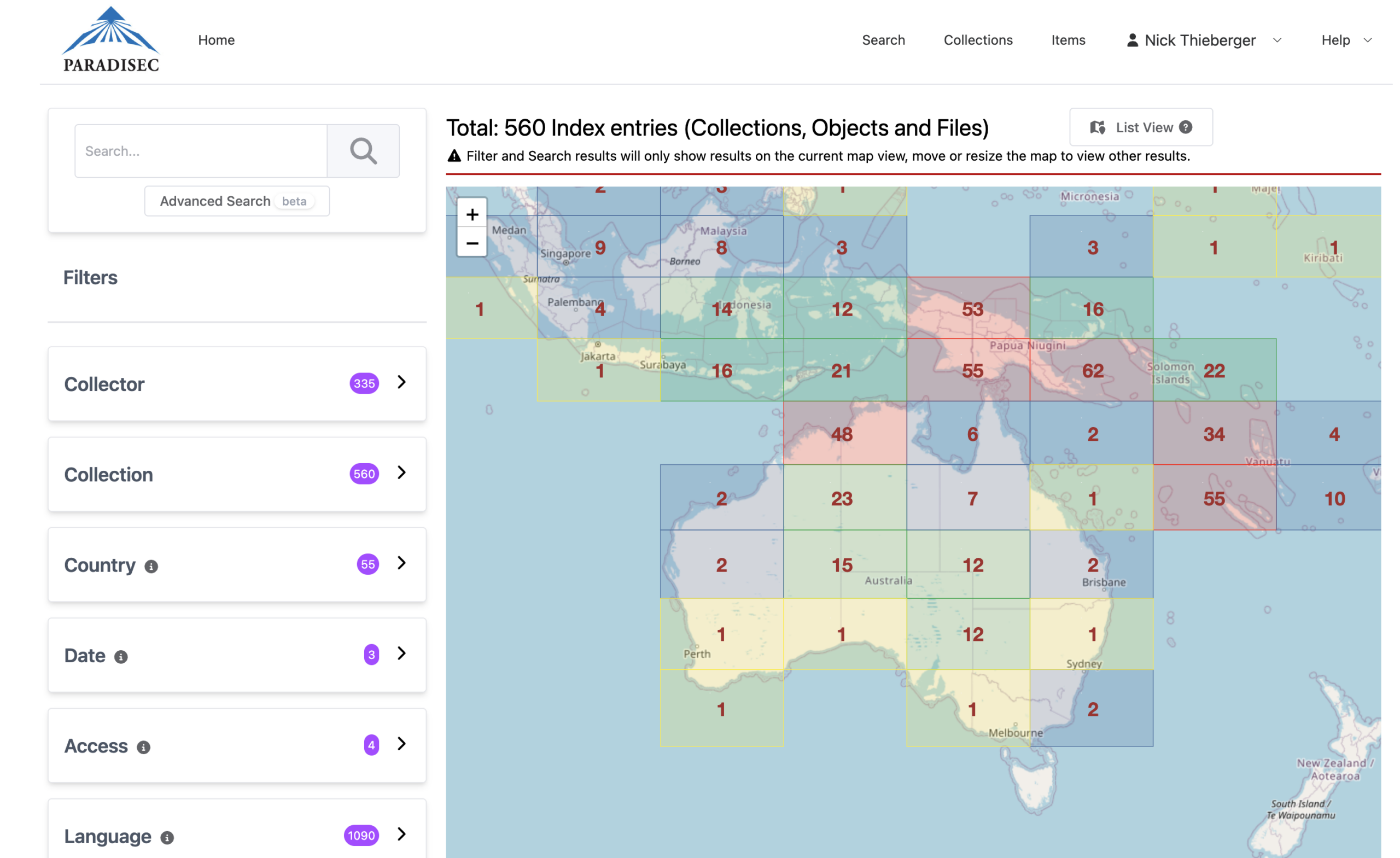
This week we launched a new way of viewing the PARADISEC catalog. We have been working towards this over the past two years, basing the approach to displaying our collections and items on the PILARS principles developed by the Language Data Commons of Australia.
We can now separate the original catalog from the view of the items in the catalog, demonstrating that any collections that have a catalog of some kind, whether in a database or in a spreadsheet, can use a single viewing system (known as Oni) and so can benefit from being in the ‘Commons’ by using shared coding effort for search and display of their metadata.
How does this work? Each item in PARADISEC has a file stored with it that contains all the metadata that is in the catalog for that item. It is written in a standard known as Research Object Crate (RO-Crate) and this is what allows any item to be copied to a new location and to still maintain its catalog description. As discussed earlier (here) we developed a method for exporting from our catalog in a format that can be used on Raspberry Pi computers for return to local communities. The new catalog offers a streamlined way of doing this, and of conforming to relevant standards so that any tools we develop can be shared by others who use RO-Crate.
Over the next months we will be adding features to the new catalog viewer like: an Elan player that will play media and transcripts together; a full text search mechanism, so that all text in Elan files or other items can be searched, in addition to the present search of metadata; and an online transcription system for media, so that users can transcribe or summarise recordings in languages they know. Each of these functions will be available to any collection that uses RO-Crates.
Work on the new catalog was funded by the Australian Research Council grant “Modularised cultural heritage archives – future-proofing PARADISEC cultural heritage. (ARC LIEF grant LE220100010, 2022-2024)”
Funding was also provided by the Language Data Commons of Australia (LDaCA) (DOI: 10.3565/kq2v-9g52) which is a co-investment partnership with the Australian Research Data Commons (ARDC) through the HASS and Indigenous Research Data Commons. The ARDC is enabled by the Australian Government’s National Collaborative Research Infrastructure Strategy (NCRIS).
 Follow
Here at Endangered Languages and Cultures, we fully welcome your opinion, questions and comments on any post, and all posts will have an active comments form. However if you have never commented before, your comment may take some time before it is approved. Subsequent comments from you should appear immediately.
We will not edit any comments unless asked to, or unless there have been html coding errors, broken links, or formatting errors. We still reserve the right to censor any comment that the administrators deem to be unnecessarily derogatory or offensive, libellous or unhelpful, and we have an active spam filter that may reject your comment if it contains too many links or otherwise fits the description of spam. If this happens erroneously, email the author of the post and let them know. And note that given the huge amount of spam that all WordPress blogs receive on a daily basis (hundreds) it is not possible to sift through them all and find the ham.
In addition to the above, we ask that you please observe the Gricean maxims:*Be relevant: That is, stay reasonably on topic.
*Be truthful: This goes without saying; don’t give us any nonsense.
*Be concise: Say as much as you need to without being unnecessarily long-winded.
*Be perspicuous: This last one needs no explanation.
We permit comments and trackbacks on our articles. Anyone may comment. Comments are subject to moderation, filtering, spell checking, editing, and removal without cause or justification.
All comments are reviewed by comment spamming software and by the site administrators and may be removed without cause at any time. All information provided is volunteered by you. Any website address provided in the URL will be linked to from your name, if you wish to include such information. We do not collect and save information provided when commenting such as email address and will not use this information except where indicated. This site and its representatives will not be held responsible for errors in any comment submissions.
Again, we repeat: We reserve all rights of refusal and deletion of any and all comments and trackbacks.